
Drain Cleaning on the South Shore of Montreal: A Homeowner Guide
Frost, basements and seasonal habits for bungalows and suburban houses in Brossard, Longueuil and Saint-Lambert.
Why the South Shore has its own drain habits
If you live in Brossard, Longueuil or Saint-Lambert, your home probably looks nothing like a Montreal plex. The South Shore of Montreal is dominated by bungalows, split-levels and suburban houses with a basement below and a yard around them. That layout shapes how drains behave. Most of your plumbing sits low in the house, close to the ground, and a lot of it ends up in the basement: the laundry, a floor drain, sometimes a second bathroom or a utility sink.
That is why drain cleaning on the South Shore is rarely only about the kitchen sink. A house with a finished basement has more places where water can back up and more at stake when it does. A slow floor drain that you notice once a month is often the first hint of a line that is narrowing further down, and it is far easier to deal with before the water reaches your carpet.
Suburban lots also tend to have mature trees. Over the years, roots look for moisture, and a buried drain line is a reliable source. Roots do not need a large opening. A small gap at a joint is enough for fine roots to enter, collect paper and grease, and slowly build a blockage. If your street is lined with big trees, this is worth keeping in mind whenever a drain starts to slow down for no obvious reason.
None of this means you should worry. It simply means that a good drain routine for a South Shore house looks a bit different from the advice you would give a condo owner downtown. Below, we walk through the seasons, the basement, the kitchen and the signs that tell you it is time to call. If you want the short version, you can read about our drain cleaning services or call us on 514-262-3337.
Frost, winter and what it does to your drains
Quebec winters are long and cold, and the ground freezes. A buried drain line does not need to be damaged by frost to feel the effects. When the ground moves and settles through repeated freezing and thawing, a pipe that was already sitting slightly off can develop a low spot, a belly where water and debris collect instead of flowing away. A line like that may work fine for months and then clog repeatedly, always in the same place.
Winter also changes how we live in the house. Windows stay closed, the heating runs, and families spend more time cooking and doing laundry indoors. More cooking means more grease going down the kitchen drain, and cold water in the pipes makes that grease harden faster. A film that would have stayed soft in August sets up on the pipe wall in January. Over a few weeks it catches food scraps, and the drain slows down.
A few simple habits make a real difference during the cold months. Wipe greasy pans with a paper towel before washing them. Keep a strainer in the kitchen sink. Run hot water for a short while after you use the sink. Do not pour hot grease down the drain, because it cools and hardens a little further along the line, where you cannot see it. And if you have a floor drain in the basement near the laundry, check once in a while that it is clear and that water drains away without delay.
If a drain clogs in the middle of winter, do not leave it for the spring. A blockage does not get better with time, and the cold only makes pipes less forgiving. We are available day and night, which matters when the problem shows up on a weekend evening in January.
Basements, floor drains and the first signs of trouble
For a South Shore house, the basement is where drain problems become visible. The floor drain is the lowest point in the plumbing system, so when the main line is partly blocked, this is where water tends to show up first. You may notice a smell, a slow gurgle when the washing machine empties, or a small amount of water that was not there before.
Pay attention to patterns. If water rises in the floor drain every time you run the washing machine, the line is probably restricted somewhere beyond the house. If the toilet gurgles when you drain the bathtub, air is struggling to move through the pipes. If more than one fixture is slow at the same time, the problem is likely in the shared line rather than in one sink. These clues help a technician narrow the cause, so describe them when you call.
Spring and heavy rain add another layer. When the ground is saturated, there is more water around buried lines, and any weak joint can let extra water in. A line that was marginal in dry weather may struggle when conditions change. This does not always mean a serious defect, but it is a good reason to have a recurring problem checked with a camera instead of just clearing it again and again.
What a camera inspection shows you
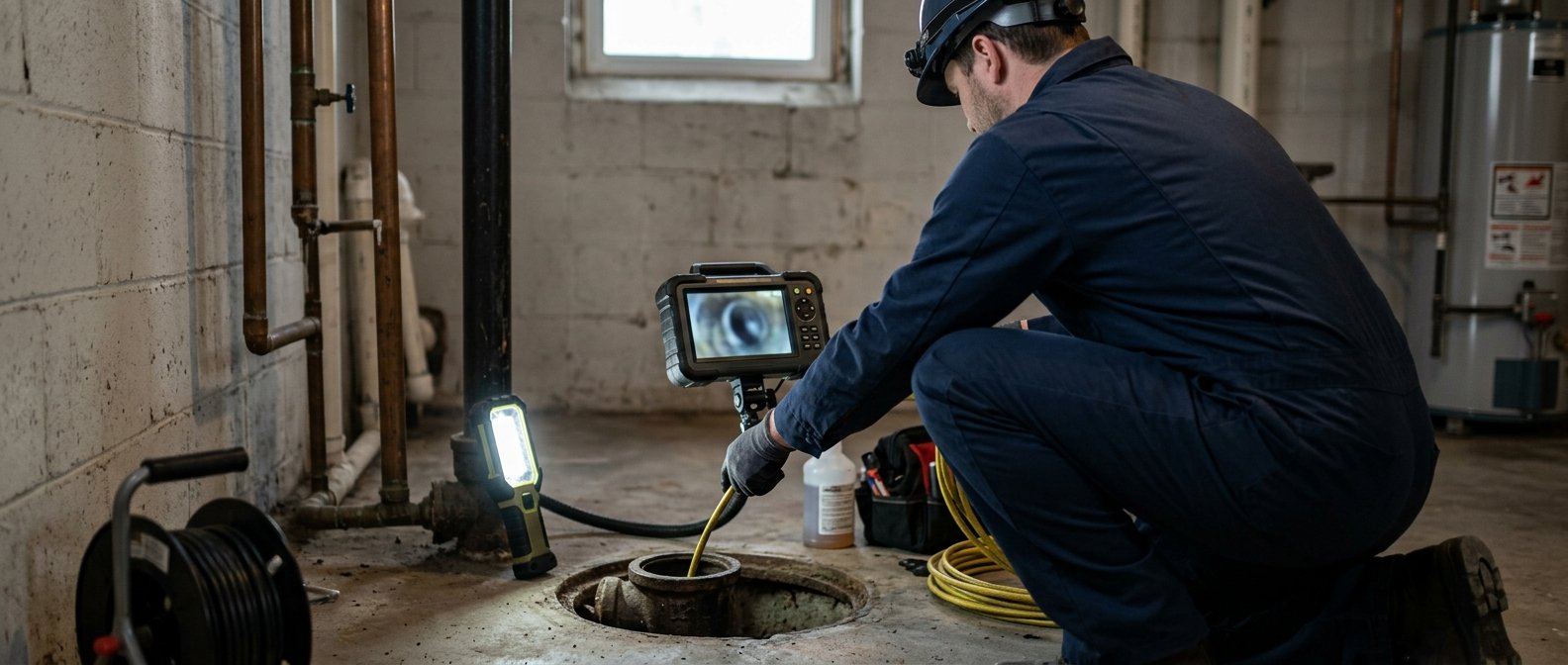
When a drain keeps coming back, guessing is expensive. A camera inspection sends a small camera through the line so the technician can see the inside of the pipe: grease buildup, roots at a joint, a low spot where water sits, or an object that should never have been there. Instead of treating a symptom, you find out what is really going on.
This is particularly useful in suburban houses where the line runs a fair distance under the lawn or driveway. You cannot see it, and you do not want to dig without knowing why. A camera inspection lets you decide calmly whether a simple cleaning is enough or whether the line needs more attention.

Hydro jetting or snaking: choosing the right method
There are two common ways to clear a blocked line. A drain snake, sometimes called a furet, bores through a blockage and restores flow. It works well for many clogs, especially a single obstruction or a soft blockage close to the fixture. Hydro jetting uses high pressure water to scour the pipe wall, which is useful when grease or scale has built up along the whole line and you want to remove it rather than just open a channel.
For a South Shore home with a recurring slow drain, the answer often depends on what the camera shows. If roots are present at a joint, they can be cut and the line cleaned, but you should expect that roots may come back over time if the opening remains. If the problem is grease, jetting is usually the more thorough option. A good technician explains both methods and recommends the one that fits your pipe rather than the one that is simply faster to set up.
We do both kinds of work, along with emergency drain unclogging when you cannot wait. You can read more about the approaches in our other local guides, such as drain cleaning on the North Shore, and our guides to drain cleaning in Montreal and drain cleaning in Laval.
Seasonal upkeep for a South Shore house
Most drain trouble is easier to prevent than to fix, and the four seasons give you a natural checklist. None of it is complicated.
Autumn. Before the cold arrives, clear leaves and debris away from any outdoor drain or grate near the house, and make sure the floor drain in the basement is accessible. If you had a slow drain over the summer, deal with it now rather than carrying it into winter.
Winter. Be careful with grease and keep an eye on the laundry area. If something gurgles or smells, do not ignore it. Cold weather makes small clogs behave like large ones.
Spring. When the snow melts and the rain arrives, check the basement floor drain and look for damp spots near it. If you have had a backup before, this is the time of year to ask for a camera inspection.
Summer. Roots are most active in warm weather, so a drain that slows down in July may be telling you something about the line outside. Heavy use, such as guests, laundry and extra showers, can also expose a line that was already close to its limit.
Brossard, Longueuil and Saint-Lambert: one service, three neighbourhood feels
These three places are all part of the South Shore, but they feel different. Brossard is a largely suburban community of houses and family streets. Longueuil is a larger city with a mix of older areas and newer developments, and Saint-Lambert sits right across from Montreal on the river side. The common thread is that homes there usually have a basement, a yard and a buried line that you rarely think about until it stops working.
We serve the whole South Shore of Montreal, day and night. Whether it is a clogged kitchen drain in a bungalow, a shower that will not drain in a split-level or a basement floor drain that is backing up, the approach is the same. We listen to what you have noticed, find the cause, explain your options and clear the line. We do not quote anything before we understand the situation, and you can ask for a free quote on the contact page.
When to call without waiting
Some problems can wait until tomorrow. Others cannot. Call right away if water is coming up in the basement, if sewage smells are strong, if several fixtures back up at once, or if a toilet will not flush and you have no other option. For these situations we offer emergency service at any hour. For a slow drain that is only mildly annoying, a plunger and a little patience may be enough, but if it returns within days, treat it as a sign that something deeper is going on.
It is also worth avoiding chemical drain openers. They can be harsh on pipes and are risky for anyone who later has to work on the line, because the liquid may still be sitting in the drain. A mechanical cleaning is usually the safer way to go.
Next steps
If your drain is acting up, start by noting what you see: which fixtures are affected, whether it happens after laundry or heavy rain, and how long it has been going on. Then call 514-262-3337 or send us a request through the form at the top of this page. You can also browse the blog index for more guides, or read our guide to drain cleaning on the North Shore if you work or have family on the other side of the river.
Frequently asked questions
How do I know if my basement floor drain needs cleaning?
Slow draining, gurgling, a musty smell or water that rises after laundry or heavy rain are the usual signs. If a plunger gives only short relief, call for a proper cleaning and consider a camera inspection.
Can frost damage a drain line on the South Shore?
Cold winters can stress buried lines and make existing problems worse. A line with a low spot or a root-damaged joint is more likely to hold water and cause trouble, which is why a camera inspection helps.
Do you serve Brossard, Longueuil and Saint-Lambert?
Yes. We serve the South Shore of Montreal, including Brossard, Longueuil and Saint-Lambert, day and night. Call 514-262-3337 or send a quote request.
Drain blocked right now?
Call us any time, day or night, or send a request for a free quote.
Call 514-262-3337